It is a scenario familiar to millions of urban adults: You wake up in the morning with a completely flat stomach, feeling light and comfortable. You eat a modest, healthy breakfast—perhaps an apple, a bowl of oatmeal, or a whole-wheat sandwich—and within 30 to 60 minutes, your abdomen expands. By mid-afternoon, your stomach feels tightly stretched like a drum, forcing you to unbutton your trousers or switch to loose elastic waistbands.
When you mention this persistent abdominal expansion to friends or online forums, the standard advice is predictable: “Drink more water,” “Eat more fiber,” “Cut out dairy,” or “Take a generic probiotic.”
Yet, for many people living in fast-paced metropolitan environments like Mumbai, following this generic advice actually makes the swelling, trapping of gas, and discomfort worse.
Chronic bloating is not a illness in itself—it is a cardinal clinical signal that something in your digestive mechanics, microbial ecosystem, or nutrient breakdown pathways is out of balance.
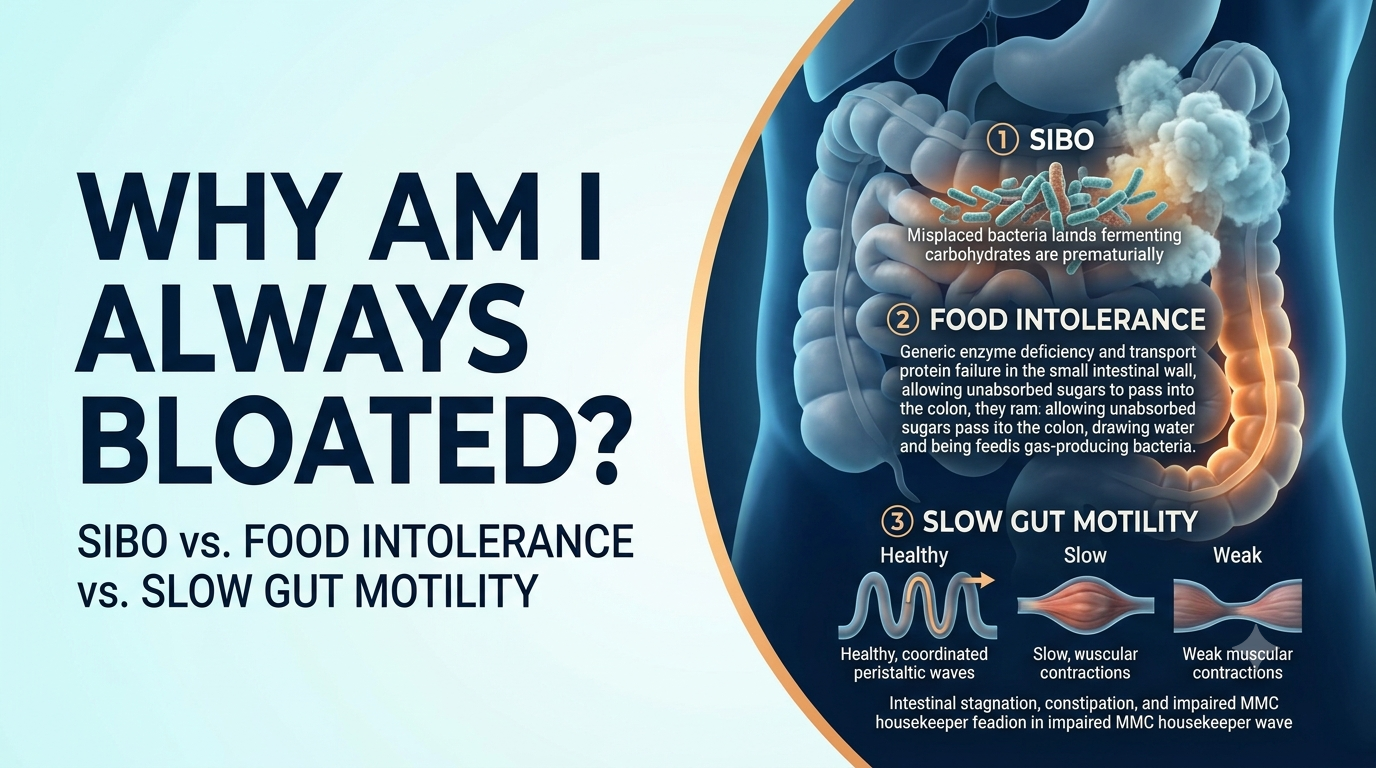
To resolve persistent gut distension, you must look beyond generic remedies and pinpoint the exact physiological driver. In modern gastroenterology, three primary culprits account for the vast majority of chronic, unexplained bloating: Small Intestinal Bacterial Overgrowth (SIBO), Food Intolerances, and Slow Gut Motility.
1. Anatomy of Bloating: Gas Volume vs. Visceral Perception
Before comparing the three primary drivers, it is essential to understand what is physically happening inside your digestive tract when you feel bloated. Clinical gastroenterology distinguishes between two related, yet distinct, phenomena:
- Bloating (Subjective Sensation): The uncomfortable internal feeling of pressure, tightness, or trapped gas within the abdomen.
- Abdominal Distension (Objective Physical Change): The visible, measurable expansion of the abdominal girth (often requiring a change in clothing size throughout the day).
Where Does Abdominal Gas Come From?
In a healthy person, the digestive tract contains a baseline volume of roughly 100 to 200 milliliters of gas at any given time. This gas originates from two sources:
- Swallowed Air (Aerophagia): Ingested while eating quickly, drinking through straws, chewing gum, or under acute anxiety.
- Microbial Fermentation: Gases produced when intestinal bacteria ferment undigested dietary carbohydrates (starches, sugars, and fibers).
In a healthy gut, as gas is produced, the smooth muscles of the intestines contract in organized waves to move the gas bubbles along, allowing them to be absorbed into the bloodstream or expelled naturally.
When you suffer from chronic bloating, one of three failures occurs: excessive rapid gas generation, impaired mechanical movement of normal gas volumes, or heightened nerve sensitivity (visceral hypersensitivity) that makes small amounts of gas feel agonizingly painful.
2. Culprit #1: Small Intestinal Bacterial Overgrowth (SIBO)
What Is SIBO?
Small Intestinal Bacterial Overgrowth (SIBO) occurs when colonic bacteria—which belong in the large intestine—migrate upward and colonize the small intestine in high concentrations.
To understand why SIBO causes severe, visible bloating, consider the anatomical difference between the small and large intestines:
- The Colon (Large Intestine): A wide, expandable tube designed to store trillions of bacteria that ferment fibrous waste at the end of digestion.
- The Small Intestine: A long, narrow 20-foot tube designed for nutrient absorption, containing relatively few bacteria.
When colonic bacteria settle inside the narrow small intestine, a conflict arises every time you eat. Within 30 to 90 minutes of consuming carbohydrates, these misplaced bacteria ferment the food prematurely inside the small intestine, producing large clouds of Hydrogen, Methane, or Hydrogen Sulfide gas.
The SIBO Gas Profile: Hydrogen vs. Methane vs. Hydrogen Sulfide
Not all SIBO presents identically. The dominant gas produced determines your specific symptoms:
Tell-Tale Signs That Your Bloating Is Driven by SIBO
- The “Pregnant by Evening” Phenomenon: You wake up with a flat stomach, but your abdominal circumference increases progressively with every meal.
- Probiotics Make You Worse: Taking commercial probiotic capsules or eating fermented foods (yogurt, kimchi, kombucha) increases gas and distension because you are feeding more microbes into an overgrown small bowel.
- High-Fiber Foods Cause Severe Pain: Eating healthy, fiber-rich foods like salads, lentils, apples, and whole grains triggers intense gas and distension.
- Extreme Brain Fog and Post-Meal Fatigue: Accompanying abdominal tightness with a feeling of heavy mental fatigue after eating.
3. Culprit #2: Food Intolerances & Malabsorption
What Is a Food Intolerance?
Unlike a true food allergy (which involves an immediate, potentially life-threatening IgE immune response causing hives, throat swelling, or anaphylaxis), a food intolerance is a non-immunological digestive failure. It occurs when your body lacks specific enzymes, transport proteins, or chemical mechanisms required to break down and absorb specific food components.
When unabsorbed sugars pass into the large intestine intact, two things happen:
- Osmotic Draw: The unabsorbed sugar molecules draw excess fluid into the bowel lumen, causing gurgling, watery diarrhea, and cramping.
- Colonic Fermentation: Resident colonic bacteria break down the unabsorbed sugars, generating carbon dioxide, hydrogen, and methane gas.
The Most Common Intolerance Triggers
1. Lactose Intolerance (Lactase Deficiency)
Lactose is the primary disaccharide sugar found in dairy products (milk, paneer, soft cheeses). Breaking down lactose requires the enzyme lactase, produced by the microvilli brush border of the small intestine. Genetics, aging, or intestinal inflammation (from viral gastroenteritis or celiac disease) can cause lactase production to drop, leading to bloating, gas, and loose motions 30 to 120 minutes after consuming dairy.
2. Fructose Malabsorption
Fructose is a monosaccharide found in fruits, honey, high-fructose corn syrup, and processed foods. Absorbing fructose requires specialized transport proteins (GLUT-5) in the small intestinal wall. When the intake of free fructose exceeds the capacity of these transporters, the unabsorbed fructose enters the colon, feeding gas-producing bacteria.
3. FODMAP Intolerance
FODMAP is an acronym for a broad group of short-chain fermentable carbohydrates:
Because human digestive enzymes cannot fully break down oligosaccharides (fructans and galacto-oligosaccharides), everyone ferments them to some degree. However, in individuals with visceral hypersensitivity or underlying gut dysbiosis, this fermentation triggers severe pain, distension, and trapped gas.
4. Non-Celiac Gluten Sensitivity (NCGS)
Distinct from Celiac Disease (an autoimmune destruction of intestinal villi) and wheat allergy, Non-Celiac Gluten Sensitivity causes real abdominal distress, bloating, fatigue, and altered bowel habits upon ingesting wheat, barley, or rye products, without triggering autoimmune antibody elevation.
4. Culprit #3: Slow Gut Motility & Impaired Clearance
What Is Gut Motility?
Your digestive system is a 30-foot continuous muscular tube. Moving food, fluids, digestive juices, and gas bubbles smoothly from mouth to rectum requires coordinated muscular contractions (peristalsis).
When gut motility slows down—a condition known as dysmotility or delayed transit—contents linger in the stomach, small bowel, or colon for far too long.
The Migrating Motor Complex (MMC): The Housekeeper Wave
Between meals and while you sleep, your small intestine performs a vital maintenance ritual called the Migrating Motor Complex (MMC).
The MMC is an electrical wave that sweeps through the stomach and small bowel every 90 to 120 minutes during fasting states. It acts as a mechanical broom, clearing residual undigested food particles, dead cellular debris, and lingering bacteria out of the small intestine and down into the colon.
If your MMC is damaged or interrupted (by frequent snacking throughout the day, chronic stress, previous food poisoning, or diabetes), the sweeping action fails. Bacteria are left undisturbed to multiply in the small bowel—making slow gut motility a primary root cause of recurring SIBO.
Key Factors That Slow Down Gut Motility
- Chronic Constipation & Pelvic Floor Dyssynergia: When the colon is filled with hard stool, trapped gas cannot navigate past the impaction, causing severe bloating.
- Constant Snacking & Grazing: Eating snacks every 1 to 2 hours keeps the digestive system in an active meal phase, preventing the MMC housekeeper wave from turning on.
- Hypothyroidism (Low Thyroid Function): Thyroid hormones ($T_3$ and $T_4$) regulate metabolic speed and smooth muscle contraction. Low thyroid levels slow intestinal transit, leading to chronic constipation and bloating.
- Autonomic Neuropathy & Diabetes: Long-standing high blood sugar levels damage the vagus nerve, impairing stomach emptying (gastroparesis) and bowel motility.
- Sedentary Lifestyle: Physical movement stimulates intestinal peristalsis. Prolonged sitting causes intestinal stagnation.
- Medications: Chronic use of opioid pain relievers, anticholinergic medications, iron supplements, and high-dose calcium channel blockers significantly slows bowel transit.
5. Comparative Breakdown: SIBO vs. Food Intolerance vs. Slow Motility
To help you identify which mechanism is driving your symptoms, review this side-by-side clinical comparison:
| Clinical Feature | SIBO | Food Intolerance | Slow Gut Motility |
|---|---|---|---|
| Primary Cause | Misplaced bacteria fermenting carbohydrates in the small intestine. | Enzyme deficiency or poor carbohydrate transporter function. | Sluggish muscle contractions; damaged Migrating Motor Complex (MMC) sweeping wave. |
| Timing of Bloating | Rapid onset: 30 to 60 minutes after consuming carbohydrates. | Delayed onset: 1 to 3 hours after eating the specific food. | Continuous, heavy fullness that worsens progressively as the day goes on. |
| Impact of Healthy Fiber & Probiotics | Worsens symptoms dramatically by feeding overgrown bacteria. | Worsens only if food contains the specific trigger sugar. | Worsens if insoluble fiber is added without adequate fluid intake. |
| Stool Pattern | Loose/watery (Hydrogen) OR severe constipation (Methane). | Loose, explosive motions; acidic liquid; loud abdominal gurgling. | Hard, lumpy, dry pellets (Bristol Scale 1-2); frequent straining. |
| Associated Signs | Brain fog, post-meal fatigue, nutrient deficiencies (such as vitamin B12). | Upper abdominal cramping, skin flushing, systemic hives (if histamine-related). | Early fullness, acid reflux, loss of appetite, infrequent bowel movements. |
| Gold-Standard Diagnostic Test | Lactulose / Glucose Hydrogen & Methane Breath Test. | Elimination-Reintroduction protocol; Lactose Breath Test. | Colonic transit time studies; Gastric Emptying Studies. |
6. Overlapping Conditions: The Vicious Cycle
In clinical practice, these three drivers rarely exist in isolation. They frequently interact, forming a self-reinforcing vicious cycle:
- Slow Motility triggers SIBO: Sluggish intestinal contractions fail to clear debris, allowing colonic bacteria to move up into the small intestine.
- SIBO creates Food Intolerances: Overgrown bacteria produce inflammation that damages the microvilli brush border of the small intestine. This destroys lactase and transport enzymes, making you secondarily intolerant to dairy, fructose, and FODMAPs.
- SIBO worsens Slow Motility: Methane gas produced by archaea organisms acts as a neuromuscular paralytic in the gut, slowing transit time even further and deepening constipation.
Breaking this cycle requires a structured diagnostic and therapeutic plan rather than trying random remedies on your own.
7. Diagnostic Testing Pathways: Moving Beyond Guesswork
If you suffer from chronic bloating, relying on self-diagnosis often leads to overly restricted diets and missed underlying issues. Modern gastroenterology uses targeted non-invasive testing to identify the exact cause.
1. Hydrogen and Methane Breath Testing (HBDT)
The primary non-invasive diagnostic tool for identifying SIBO and lactose/fructose malabsorption:
- Preparation: The patient follows a simple 24-hour prep diet (white rice, plain chicken, eggs) followed by an 12-hour overnight fast.
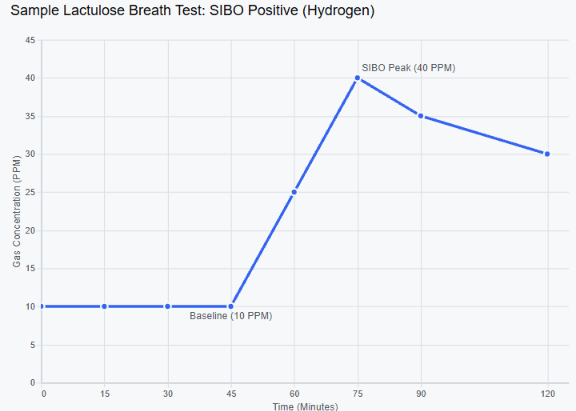
- Testing: After establishing a baseline breath sample, the patient drinks a measured lactulose or glucose solution. Exhaled breath samples are collected every 15 to 20 minutes over 2 to 3 hours and analyzed using gas chromatography.
- Diagnostic Interpretation:
- Hydrogen SIBO: A rise in hydrogen gas of $\ge 20\text{ ppm}$ above baseline within the first 80 to 90 minutes indicates bacterial fermentation inside the small intestine.
- Methane (IMO): A methane reading of $\ge 10\text{ ppm}$ at any point during the test confirms an overgrowth of methane-producing organisms.
2. Screening for Celiac Disease
Before assuming symptoms are due to simple IBS or gluten sensitivity, your doctor will check Anti-Tissue Transglutaminase (anti-tTG IgA) antibody levels while you are still eating gluten. This rules out Celiac Disease, an autoimmune condition that flattens intestinal villi.
3. High-Definition Endoscopy & Colonoscopy
If you have alarm features (such as unexplained weight loss, bleeding, anemia, or late-onset symptoms), an upper endoscopy or colonoscopy allows your specialist to visually inspect the mucosal lining, take targeted tissue biopsies, and rule out structural issues, peptic ulcers, inflammatory bowel disease (IBD), or polyps.
8. Targeted Treatment Protocols
Because each root cause operates differently, effective treatment requires a tailored approach:
Treatment Protocol for SIBO
- Targeted Eradication Therapy: Non-absorbable, site-specific antibiotics (such as Rifaximin for Hydrogen SIBO, or Rifaximin combined with Neomycin or Metronidazole for Methane SIBO) travel through the small intestine to reduce misplaced bacteria without disrupting the broader colonic ecosystem.
- Prokinetic Motility Support: Following antibiotic therapy, prokinetic agents (such as low-dose Erythromycin, Prucalopride, or natural botanical prokinetics containing ginger and artichoke extract) are prescribed at bedtime to restart the MMC housekeeper waves and prevent recurrence.
- Short-Term Dietary Modification: A temporary Low-FODMAP diet reduces fermentable fuels while the intestinal mucosa heals.
Treatment Protocol for Food Intolerances
- The 3-Phase Low-FODMAP Protocol: Under clinical supervision, trigger foods are eliminated for 2 to 6 weeks to calm symptoms, systematically reintroduced one group at a time to identify specific triggers, and then personalized to maintain a broad, nutritious diet.
- Enzyme Supplementation: Using targeted enzyme supplements (such as lactase for dairy or alpha-galactosidase for lentils and beans) allows you to enjoy meals without triggering symptoms.
Treatment Protocol for Slow Gut Motility
- Implement Inter-Meal Fasting (The 4-Hour Rule): Space meals 4 to 5 hours apart without snacking. This gives your digestive system time to enter a fasting state, allowing the MMC wave to sweep clean the small intestine.
- Optimize Hydration & Soluble Fiber: Increase water intake alongside gentle, soluble fiber (such as fine psyllium husk) to soften stool without causing excess fermentation.
- Pelvic Floor Physical Therapy: If bloating is driven by pelvic floor dyssynergia (inability to relax pelvic floor muscles during defecation), biofeedback physical therapy helps retrain healthy elimination mechanics.
9. Lifestyle & Habits to Reduce Daily Bloating
Alongside medical management, adopting these evidence-based habits can help minimize daily gas trapping and support healthy motility:
- DAILY BLOATING PREVENTION CHECKLIST
- ✓ Chew Thoroughly: Aim for 20 to 30 chews per bite to mix food with salivary amylase and lighten the stomach’s mechanical workload.
- ✓ Eliminate Aerophagia Triggers: Stop drinking through straws, avoid chewing gum, and limit carbonated beverages.
- ✓ Take a Post-Meal Walk: A gentle 10 to 15 minute stroll after eating stimulates gastric emptying and speeds gas clearance through the gut.
- ✓ Practice Diaphragmatic Breathing: Deep belly breathing before meals activates the parasympathetic “rest and digest” nervous system, relaxing the abdominal wall.
- ✓Avoid Eating Within 3 Hours of Bedtime: Lying down with a full stomach slows digestion and increases acid reflux and nighttime gas trapping.
10. Summary: Reclaiming Comfortable Digestion
Living with chronic bloating is frustrating, exhausting, and disruptive to daily life. However, it is not something you simply have to accept or manage with endless antacids and restrictive diets.
To resolve persistent abdominal distension, look beyond temporary fixes and identify your true root cause:
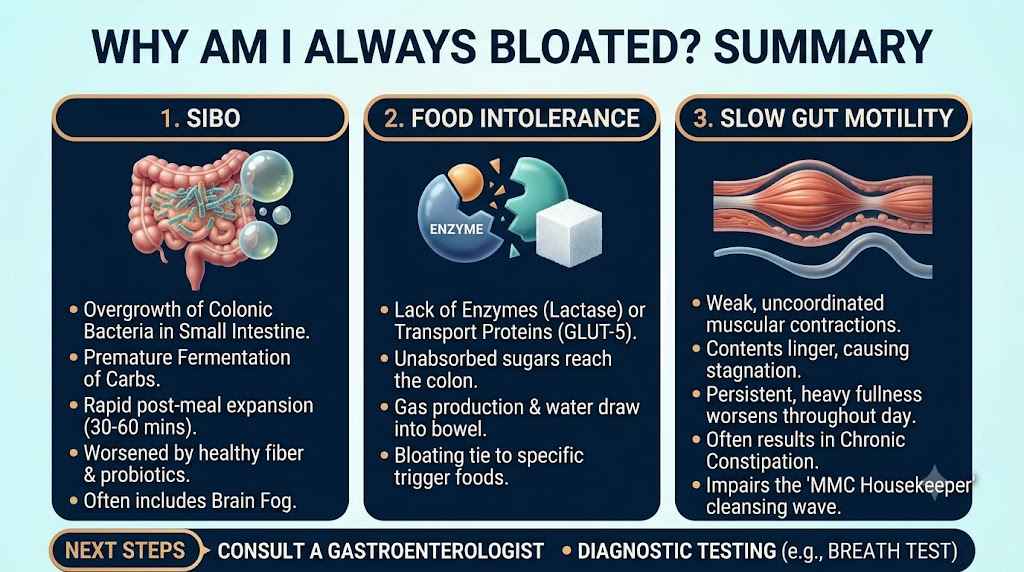
- Is it SIBO? (Rapid post-meal expansion, worsened by fiber and probiotics, accompanied by fatigue and brain fog.)
- Is it a Food Intolerance? (Delayed gas, cramping, and loose motions tied to specific dietary sugars like lactose or fructose.)
- Is it Slow Gut Motility? (Continuous heavy fullness, severe constipation, straining, and an impaired MMC housekeeper wave.)
By consulting a qualified gastroenterologist, completing accurate diagnostic testing—such as Hydrogen and Methane Breath Testing—and following a targeted treatment plan, you can break the cycle of chronic distension and enjoy comfortable, reliable digestion once again.